
How SolCrys Works
Company memory for AI agents: many writers, many readers, one set of rules
Anthropic's new study tests how AI agents keep and correct what they learn. This essay reads its experiments for a harder case: memory about a company, shared by every agent that works for it.
By Eason Wang, Co-Founder & CPO, SolCrys
Published · Updated
Questions this guide answers
- What is company memory for AI agents?
- What does Anthropic's agent-memory research mean for company knowledge?
- Should AI agents be allowed to change company facts on their own?
- How do you keep AI agents' knowledge of a company up to date?
- What should stay out of an AI agent's company memory?
Direct answer
Company memory is what AI agents keep about a business between sessions: what it sells, what it may claim, its proof and its rules. Agents read it before they write, review or grade anything. Anthropic's experiments suggest that what an agent keeps, and how it corrects it, matters more than how much it keeps. A company's memory adds a problem the study mostly sets aside: many people and agents write to it, and many agents read it.
We're rebuilding Corporate Context, the memory SolCrys agents keep about each customer's company, around four rules. They also work as a check for any team running more than one agent on brand work:
- Rank the writers. An automated job can't overwrite a fact a person confirmed. It proposes a change; a person decides.
- Give every reader the same version. The agent that drafts and the check that grades read one copy of each page, assembled the same way.
- Store facts, with their sources. Each fact says where it came from. Choices, your own grades and unannounced plans stay out.
- Write back what you learn. Anything that researches the company files what it finds, under the first rule.
How Anthropic describes agent memory
On Nov. 6, Anthropic published The components of agent memory, the most detailed public account I've read of how an agent keeps what it learns. It defines memory narrowly: knowledge an agent gains from experience and keeps between sessions as text it can read later. Changes to a model's weights and summaries of a long conversation don't count.
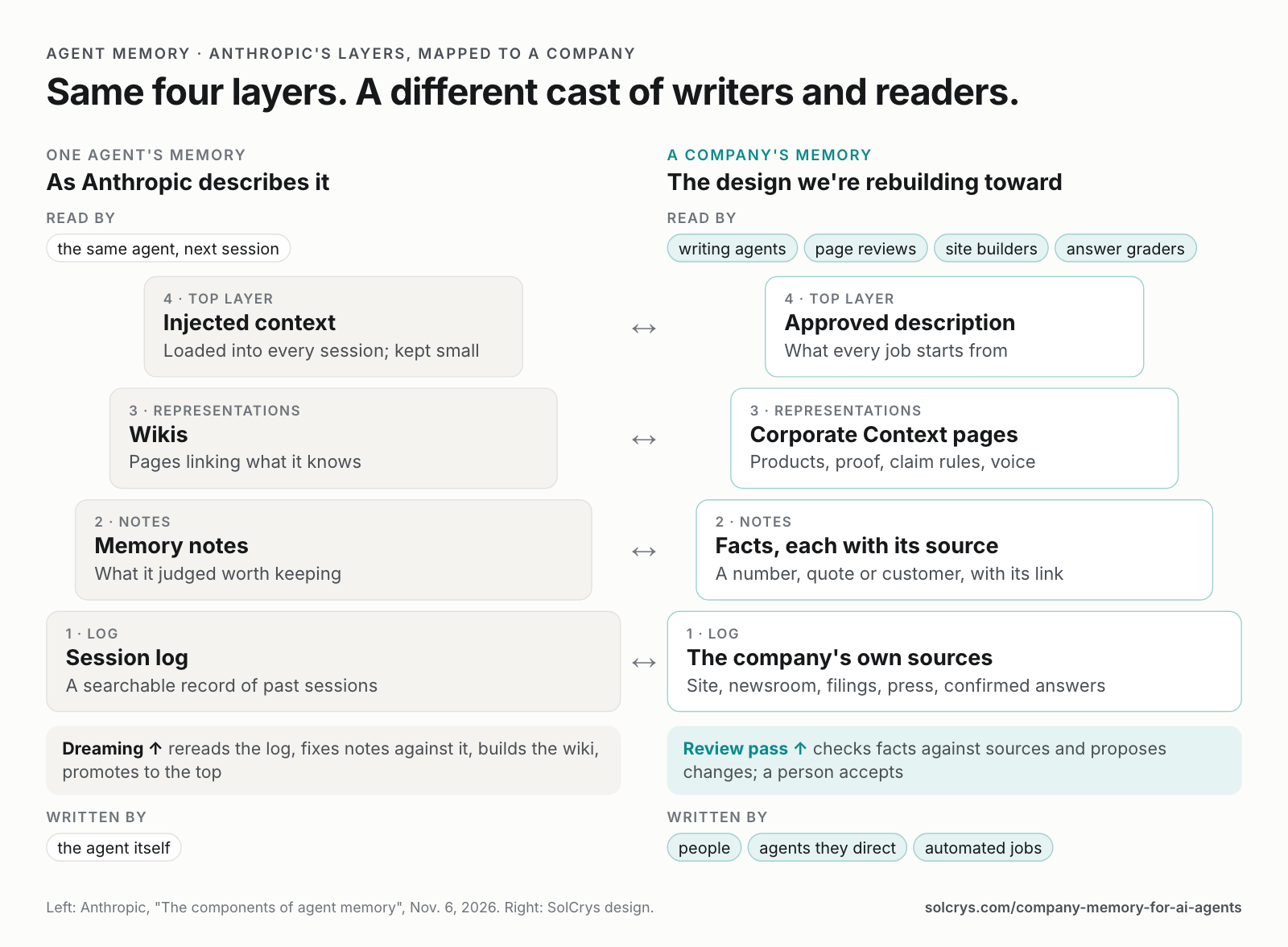
The study arranges memory in four layers. At the bottom is a searchable log of past sessions. Above it are notes the agent writes when something seems worth keeping. Above those are representations, such as a wiki that gathers and links what the agent knows about one subject. At the top is a small block of context loaded into every new session. A background pass called dreaming rereads the logs, corrects notes against them, builds the wiki and decides what moves up to the top.
Each layer has a counterpart in a company's memory. What differs is the cast: one agent on the left, many writers and readers on the right.
What the experiments show, read for a company
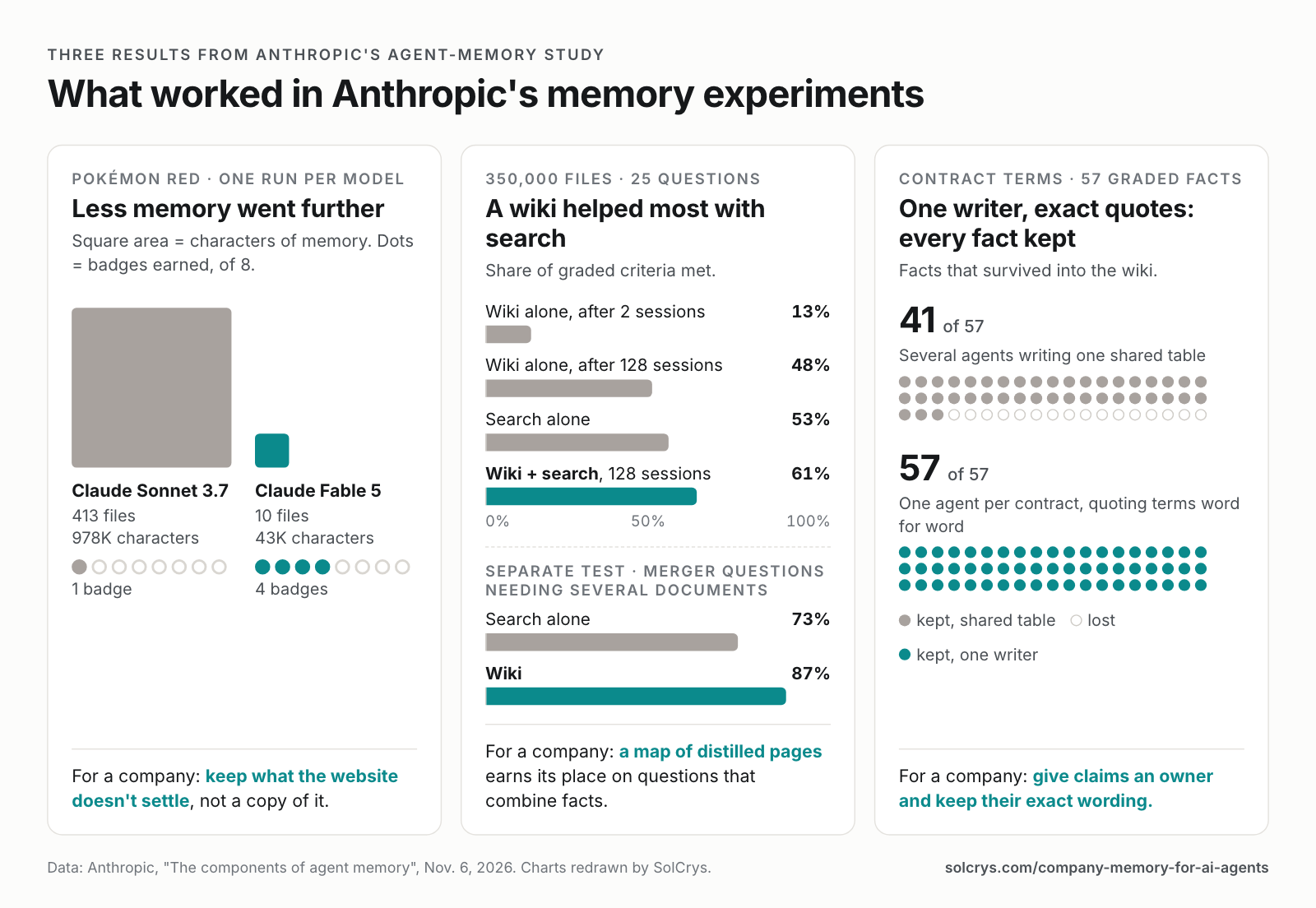
The study runs experiments on notes, corrections and wikis. Five of its findings carry over to memory about a business, and the figure shows three of them.
1. Keep what you can't look up
Anthropic compared two models' memory folders about 10,000 steps into Pokémon Red. Claude Sonnet 3.7 had written 413 files across 225 folders, often a file for each battle, item and character, and it earned one badge. Claude Fable 5 had kept 10: a dashboard file plus notes on routes and strategy. It earned four. Part of the larger folder recorded what the game shows on screen every turn, such as money and position, and its detailed record kept going out of date.
For a company, the screen is its public website: an agent can read any live page whenever it needs to. Memory earns its place by holding what the site doesn't settle: which claim is approved, which number is current when two pages disagree, what must never be said, and who confirmed it.
2. A wrong note is trusted until something checks it
In another run, Claude noted that the Pokémon Center at Mt. Moon was on the east side of the mountain. It wasn't. Trusting the note, Claude walked off a one-way ledge and dropped back onto the route it had come from, three times, and the run ended without reaching the next city. When a dreaming pass checked the note against the session log, it caught the error and rewrote it. With the corrected note, Claude went back into the cave and reached Cerulean City.
Company memory goes wrong the same way: a price that changed, a certification that lapsed, an executive who left. Every agent that reads the stale fact repeats it with confidence. Correcting it needs a ground truth, and for a company that is its own published sources.
3. A map pays off when answers span documents
Anthropic had agents build a wiki over about 350,000 internal files from Stainless, a company it acquired. On 25 questions about them, the wiki plus a search tool met 61% of graded criteria, against 53% for search alone. In a separate test on a merger's documents, the wiki scored 87% against 73% for search on questions that needed several documents. On a task where most answers sat in one document, it showed no clear gain. On another, the wiki grew to 1.77 times the size of its documents: it had abstracted almost nothing.
Corporate Context plays the map's role for a company. By the same logic, it should help most with questions that combine facts, such as whether the plan a buyer asks about includes the certification they need, and stop helping if it grows as large as its sources.
4. Shared pages lose facts
In a contract task, several agents wrote terms into one shared table at the same time and overwrote one another's work. A brief built from that wiki included 41 of 57 graded facts, or 72%. The instructions had never said the contract terms mattered most. Anthropic then ran a loop in which Claude reflected on the failures and rewrote the instructions: each contract got its own page, written by one agent, quoting the terms word for word. All 57 facts survived, and the brief could meet every graded criterion.
In a company's memory, the facts that matter most, such as prices, certifications and named customers, need the same treatment: one owner each, and the exact wording.
5. The top layer has to stay small
Whatever sits in the top layer loads into every session, so a wrong note there reaches every session, and the study notes that Claude Code's documentation warns longer instruction files are followed less closely. Claude Code keeps its own memory index small for this reason: it loads only the first 200 lines or 25 KB.
In a company's memory, the top layer is the short approved description that every job starts from. One wrong sentence there reaches every agent that writes or grades for the company.
What changes when the memory is about a company
Most of the study follows agents remembering their own work, whether one agent playing a game or several building one wiki for one task. A company's memory has writers with different authority and readers with different jobs. Put memory of a task, of a person and of a company side by side, and the difference is who writes and who reads.
| Memory of a task | Memory of a person | Memory of a company | |
|---|---|---|---|
| Who writes it | The agent doing the work | An assistant, from what the person tells it | Marketing, product and legal teams, the agents they direct, and automated jobs |
| Who reads it | The same agent, next session | That assistant | Every agent that acts for the company: writers, reviewers, site builders, the checks that grade AI answers |
| Who settles a conflict | The latest result the agent has checked | The person's own words | What the company has approved; a person outranks an automated job |
| What makes it stale | The task's environment changes | The person's life changes | The company launches, hires, raises money and renames things |
The rules live with the memory
When one agent owns its memory, the rules for keeping it can live in that agent's instructions. When many writers and readers share it, rules kept in each one's instructions drift apart, and nothing notices until two agents disagree about the company. So the rules have to sit with the memory itself, where every writer and reader meets the same ones.
Rule 1: rank the writers
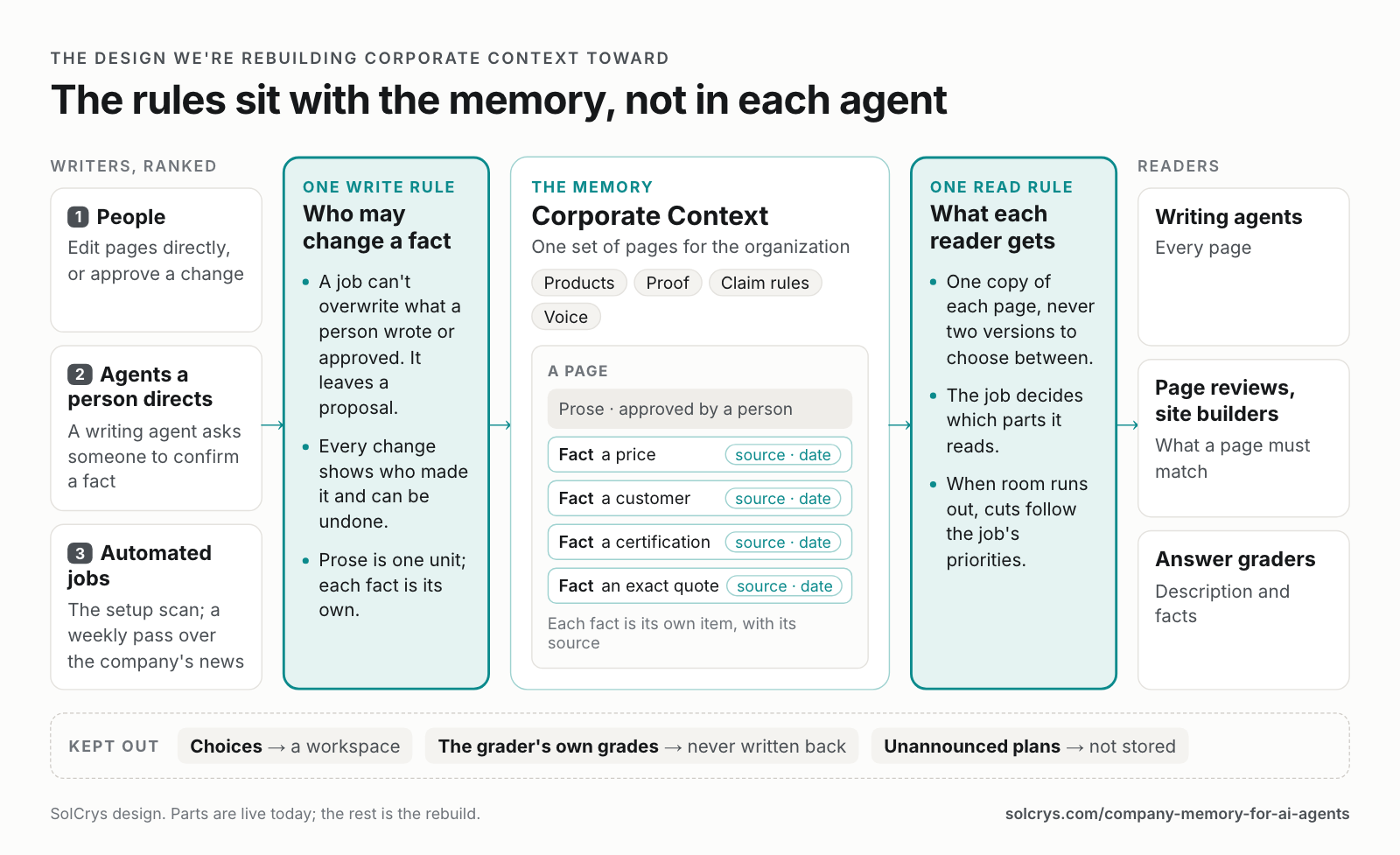
A company's memory has three kinds of writer: people editing it directly, agents working for a person, such as a writing agent that asks someone to confirm an integration, and automated jobs, such as the scan that builds the memory at setup or a weekly pass over the company's news. Without an order among them, the last writer wins, which is how facts disappeared in the contract task.
The order: an automated job can't overwrite what a person wrote or approved. It leaves a proposal beside it, and nothing changes until a person accepts it. Every change shows who made it and can be undone, so a team can afford to let machines write.
Granularity matters as much as order. If a whole page is one unit, a job that finds one new customer has to rewrite prose a person approved, or give up. The rebuild treats a page's prose as one unit and each fact as its own, so a job can add a sourced fact without touching sentences a person wrote.
These rules decide who may change a fact, not what an agent should notice. The difference matters: Anthropic found that fixed rules about what to write can backfire. Told to record only failures, Claude Opus 5 lost much of the gain memory gave it. Judgment about what's worth keeping stays with the agent. Authority over what the company states stays with people.
Rule 2: give every reader the same version
A company memory has more readers than writers. At SolCrys, the same Corporate Context grounds the agents that draft content, the audit that reviews pages, and Answer Accuracy, which grades whether an AI engine described the company correctly.
Three details decide whether those readers agree, and the rebuild settles all three in one read rule that sits with the memory. First, one copy of each page: a reader never gets two versions of the same page to choose between. Second, the job decides which parts it reads: a writer needs the voice rules, and a grader doesn't. Third, when a job runs out of room, what gets cut follows the job's priorities, not the order the pages happen to be stored in.
Rule 3: store facts, with their sources
The most useful decisions were about what to keep out.
- Choices. Which questions to track and which rivals to measure share of voice against are decisions a team makes per market or product line. In SolCrys they belong to a workspace, while one Corporate Context serves every workspace in the organization. Stored as company facts, preferences would read as truth to every agent.
- Your own grades. Answer Accuracy grades engine answers against the memory. If those grades flowed back in, the memory would drift toward what the grader already believes, and the check would end up confirming itself.
- Unannounced plans. Every agent that reads company memory writes for someone, so anything in it can end up quoted. A roadmap item in memory is one draft away from a public page.
Every fact keeps its source
What does get in says where it came from. When a machine adds a fact, the fact has to be checkable against the page it came from: a number must appear in the source, a quote must be word for word, a customer must be named, and the link and date come from the source itself. Anything that fails stays out.
The study points the same way. On a database task, Claude Opus 5 and the models after it turned their mistakes into checked rules: most of Opus 5's memory entries stated a rule and how it knew the rule was true. And the contract facts survived once they were quoted instead of summarized. For why sourced, current facts decide what AI gets right about a brand, see Why grounding depth decides whether AI gets your brand right.
Rule 4: write back what you learn
Most company memory is written once, at setup, and then read for months while the company launches products, signs partners and publishes case studies. The study sees the same drift from the agent's side and names two open questions: when to write memory, and how to keep it current without rechecking everything.
A company's memory suggests an answer to both. Write in the moment when a person is there to confirm: when a writing agent asks someone to confirm a fact for a draft, the answer should go into memory then, so the next draft doesn't ask again. Write in the background for the rest. Most of what changes at a company is announced in public, in its newsroom, on its blog and in press coverage, and agents that already read those sources can file what they find, with the link, under the first rule.
For what to recheck, the study suggests focusing the background pass on what is likely to change. For a company that list is short: prices and plans, products and integrations, certifications, leadership, customers and published numbers. A founding year doesn't need a weekly check. A pricing page does.
Where Corporate Context stands today
In SolCrys today, people edit Corporate Context in the dashboard, and agents connected through the SolCrys MCP server can read it and, with an admin's permission, propose changes for a person to review. Every change shows who made it, and any page can be restored to an earlier version. When SolCrys builds Corporate Context automatically at setup, it never overwrites a page a person has edited; it leaves a replacement draft instead.
About the author
Eason Wang is Co-Founder & CPO of SolCrys. He holds a PhD in Machine Learning and has spent 18+ years building enterprise products, starting at Microsoft Research Asia. His current focus is agentic AI workflows and the infrastructure required to run them in production. Connect on LinkedIn.
Written November 2026. For what Corporate Context contains, see Corporate Context is the new CMS; for the harness it feeds, see Models change. The harness compounds.
Sources
FAQ
Is company memory the same as a search index over company documents?
No. A search index finds passages in source documents when a question comes in. Company memory sits above the sources: what the company has approved, by topic, each fact stated once and linked to where it came from. In Anthropic's tests on about 350,000 files, the two worked best together. A company's memory is small enough that the job, not a search step, decides what an agent reads, which is why we haven't built a search index. We'll add one when the pages a job needs stop fitting in its context.
Free ChatGPT visibility check
See where AI answers skip your brand — then fix it, free
Start a free workspace with your domain: 10 buyer-intent prompts through ChatGPT show where you are mentioned, cited, or skipped, and who gets recommended instead. A free content audit in the same workspace hands you the first fix to ship.
Free · No credit card · About 5 minutes
Related guides
How SolCrys Works
Corporate Context Is the New CMS
Corporate Context gives AI marketing agents the brand facts, claims, guardrails, and evidence they need to execute safely across AEO workflows.
Strategy & Positioning
Models Change. The Harness Compounds.
Eason Wang, SolCrys CPO, on why the model isn't the moat, bought or fine-tuned, and what compounds instead: model portfolios, scenario evals, a harness.
Risk Monitoring
Why Grounding Depth Decides Whether AI Gets Your Brand Right
AI answer accuracy about your brand is only as good as the truth you grade against. A thin baseline context catches crude contradictions; a deep, cited, current source of truth catches drift — and the claims a shallow context is silent about.
Risk Monitoring
When AI Describes Your Brand, Is It Telling the Truth?
AI answers drop claims you earned, quote prices you retired, and assert things you never said, and that text can be steered on purpose. How to grade every AI answer against your own grounding truth, with receipts.
How SolCrys Works
How to Set Up a SolCrys Workspace: A Best-Practices Guide
What a SolCrys workspace is, the two ways to create one, and the best practices that keep your AI-visibility measurement clean: scoping the category, when to use multiple workspaces, engines, competitors, Corporate Context, and the prompt set.
MCP & Skills
SolCrys MCP and Skills: tools, install, and the workflows that chain them
A practical reference for the SolCrys MCP server and the six open-source AEO Skills. The core tools cataloged, OAuth and PAT install paths, the seven-step typical workflow, and how the Skills auto-chain MCP calls inside Claude, Cursor, and other AI clients.